Love this? Save it for later!
Share the inspiration with your friends
That first crunch—the snap of a crisp apple slice followed by the burst of a juicy blueberry, all threaded onto a wooden skewer in a perfect arc of color—still takes me straight to my aunt’s backyard last June. My niece had just turned four, and the picnic table was covered with bowls of cut fruit, marshmallows, and what felt like a thousand skewers. The kids were supposed to be helping, but mostly they were sneaking strawberries and arguing over who got the star-shaped cookie cutter. Somewhere between the chaos and the juice-stained fingers, I realized these Easy Rainbow Fruit Kabobs Kids Love weren’t just a snack. They were the kind of thing that makes you stop and think—this is what summer is supposed to taste like.
Honestly, I didn’t set out to make a recipe that day. I was just trying to keep a toddler entertained long enough to eat something that wasn’t goldfish crackers. But watching her carefully line up a piece of cantaloupe next to a green grape, then step back to admire her work like she’d just hung a painting in a gallery—that got me. Fruit kabobs feel like play, but they’re packed with real nutrition. And if you’ve ever tried to convince a picky eater that a bowl of fruit is exciting, you know how valuable that is.
These skewers have become my go-to for playdates, birthday parties, and those afternoons when the kids are bouncing off the walls and I need a win. They’re simple enough for little hands to help assemble, colorful enough to feel like a treat, and versatile enough to work with whatever fruit you have on hand. There’s no special equipment, no complicated steps, and no sugar-coated tricks. Just real food that looks like a party on a stick. And honestly? That’s the kind of recipe that sticks.
Why You’ll Love This Recipe
I’ve tested this recipe more times than I can count—with my own kids, with neighborhood friends, and even at a classroom party where the teacher asked me to bring “something healthy but fun.” Every single time, these kabobs disappear faster than anything else on the table. Here’s why they work so well:
- Quick & Easy: You can prep and assemble a full batch in under 15 minutes. No cooking, no waiting, no complicated steps.
- Simple Ingredients: Everything comes from the produce section. No fancy syrups, no processed additives, no hidden sugars.
- Perfect for Parties: Birthdays, barbecues, school events, or just a Tuesday afternoon—these fit everywhere.
- Crowd-Pleaser: I’ve yet to meet a kid (or adult) who turns down fruit on a stick. It’s basically magic.
- Unbelievably Delicious: The combination of textures—crunchy apples, juicy grapes, creamy banana slices—makes every bite different and satisfying.
What sets this recipe apart from the usual fruit salad? It’s the presentation, honestly. Something about threading fruit onto a skewer makes it feel special. Kids who normally push their fruit around the plate will grab a kabob and eat the whole thing without thinking. And from a parent’s perspective, it’s a total win—no added sugar, no preservatives, just whole fruit in a format that feels like play.
This is the kind of recipe that makes you close your eyes after the first bite—not because it’s complicated, but because it’s exactly right. It’s comfort food reimagined as a healthy snack, and it delivers the same soul-soothing satisfaction without the guilt. Perfect for impressing other parents at a playdate, or just turning a regular afternoon into something a little more memorable.
What Ingredients You Will Need
This recipe uses simple, wholesome ingredients that you can find at any grocery store. The beauty of these kabobs is that they’re completely flexible—you can swap fruits based on what’s in season, what’s on sale, or what your kids actually eat. Here’s what I typically use:
For the Fruit Kabobs:
- Strawberries, hulled and halved (or quartered if they’re large) — the red in the rainbow, plus they’re sweet and juicy
- Cantaloupe or honeydew melon, cut into 1-inch cubes — the orange or green layer, depending on which you choose (I prefer cantaloupe for color contrast)
- Pineapple chunks, fresh or canned (drained) — the yellow section, and they add a nice tropical tang
- Green grapes, seedless — the green part, and they hold up well on skewers without getting mushy
- Blueberries — the blue/purple section, and they’re perfect for little fingers to grab
- Red or purple grapes — for the purple/violet end, though blackberries or plum slices work too
- Wooden skewers, 8 to 10 inches long — standard kabob skewers work great
Optional Add-Ins:
- Marshmallows — for a fun treat, thread one between fruit pieces (my kids love this)
- Mini cheese cubes — cheddar or mozzarella add protein and make it more filling
- Yogurt dip — plain Greek yogurt mixed with a drizzle of honey or a splash of vanilla
- Coconut flakes — unsweetened, for a tropical twist
A few notes from my kitchen: I always look for fruit that’s ripe but still firm. Overripe strawberries get mushy on the skewer and slide right off. For melon, I prefer cantaloupe from a trusted brand like Del Monte or Fresh Express—they consistently have good texture. And if you’re using canned pineapple, get the chunks packed in juice, not syrup. It makes a difference in both flavor and sweetness.
For substitutions, you can really use any fruit your family likes. Kiwi slices work beautifully for green. Mango cubes are amazing for yellow-orange. Raspberries and blackberries add great texture but can be a bit delicate—I usually put them at the end of the skewer so they don’t get crushed. And if you’re avoiding sugar entirely, just skip the marshmallows and use fruit alone. The natural sweetness is plenty for most kids.
Equipment Needed
You don’t need much for this recipe, which is part of why I love it. Here’s what you’ll need:
- Wooden skewers, 8 to 10 inches long — standard kabob skewers are perfect. I buy them in bulk at the grocery store. If you’re serving very young children, you can snap them in half to make shorter skewers.
- Cutting board — a large, stable one makes prep faster. I use a bamboo board that’s easy on my knives.
- Sharp knife — a good chef’s knife or paring knife for cutting fruit into uniform pieces. A dull knife makes melon cubes frustrating.
- Melon baller (optional) — if you want perfectly round melon pieces, this is a fun tool. But honestly, cubes work just as well and are easier for kids to help with.
- Large platter or serving tray — to arrange the finished kabobs. A white platter makes the colors pop beautifully.
- Small bowls — for holding prepped fruit. I use a few small mixing bowls to keep everything organized.
If you don’t have wooden skewers, you can use sturdy plastic straws or even clean chopsticks. For a party, I’ve also used colored plastic skewers that come in rainbow colors—they’re reusable and add even more visual fun. Just make sure whatever you use is food-safe and has a blunt end if kids are handling them.
One tip: if you’re prepping for a large group, a fresh cowboy caviar and these kabobs make an incredible summer spread together. The colors complement each other, and both are no-cook recipes that keep you out of a hot kitchen.
Preparation Method
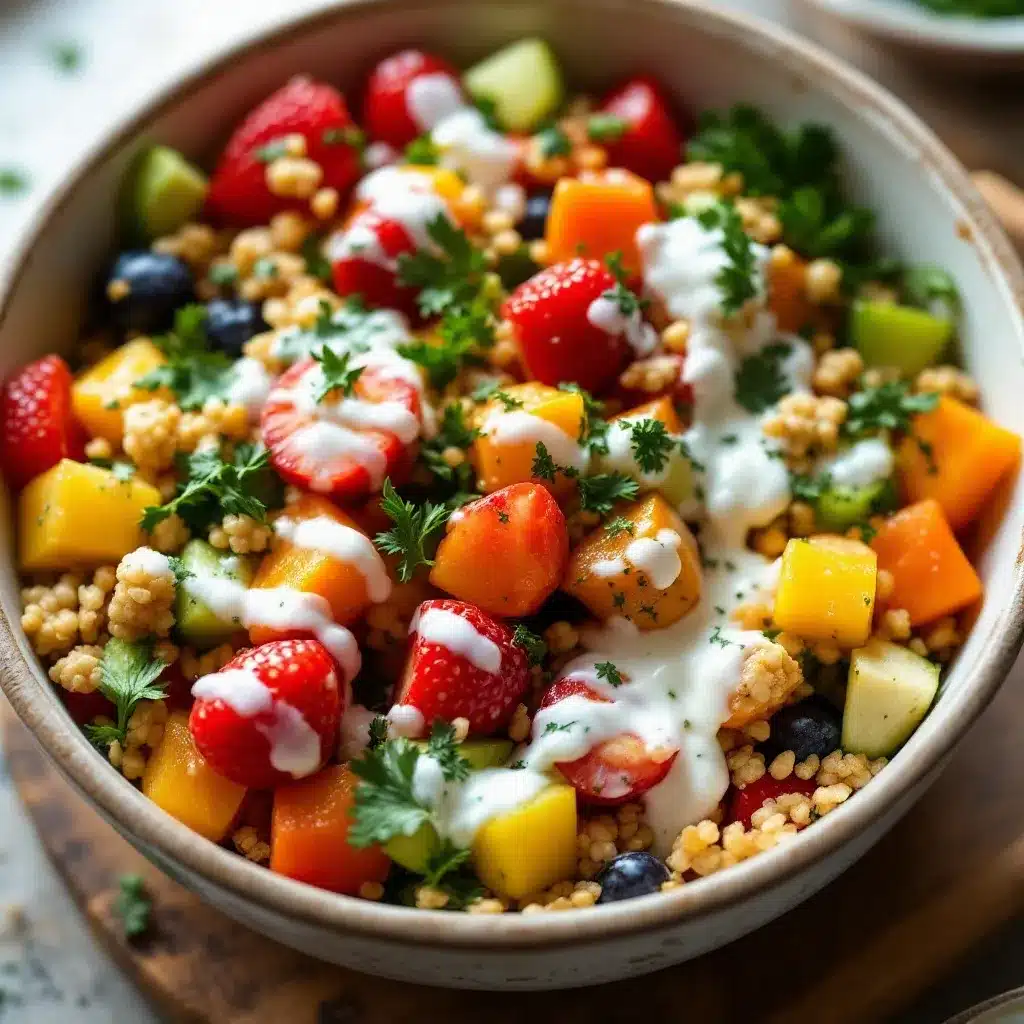
These kabobs come together fast once you’ve prepped the fruit. The key is to cut everything into similar-sized pieces so they thread evenly and look uniform on the skewer.
- Wash and dry all fruit thoroughly. Pat it dry with a clean kitchen towel or paper towels. Wet fruit slides around on the skewer and makes assembly messy. Take your time here—it makes the next steps so much easier.
- Prep each fruit type. Hull the strawberries and cut them in half (or quarters if they’re large). Cut the cantaloupe into 1-inch cubes—try to make them roughly the same size as your pineapple chunks. Leave the grapes whole. Blueberries can go on as-is. If you’re using red or purple grapes, leave them whole too.
- Arrange the fruit in separate bowls. This is a great step to delegate to kids—they love sorting the colors. I usually set out six small bowls in rainbow order: red (strawberries), orange (cantaloupe), yellow (pineapple), green (green grapes), blue (blueberries), and purple (red grapes).
- Start threading the skewers. Take a wooden skewer and begin with a strawberry piece at the bottom (the blunt end). I always start with red because it anchors the skewer nicely. Push the fruit about halfway down the skewer, leaving enough room for a handle.
- Follow the rainbow order. After the strawberry, add a cantaloupe cube, then a pineapple chunk, then a green grape, then a few blueberries, and finish with a red or purple grape. Leave about an inch of skewer at the top for easy handling. For younger kids, I sometimes add a marshmallow at the very top as a treat.
- Repeat with remaining skewers. Each skewer should have roughly 6 to 8 pieces of fruit, depending on size. I usually get about 12 to 15 kabobs from a standard batch. If you’re making these for a party, plan on 1 to 2 kabobs per person.
- Arrange on a platter. Lay the finished kabobs in a single layer on a large serving tray. If you want to get fancy, arrange them in a rainbow arc or a sunburst pattern. The colors really pop against a white or light-colored platter.
- Serve immediately or refrigerate. These are best eaten within a few hours of assembly. If you’re making them ahead, cover the platter with plastic wrap and store in the fridge. Add a squeeze of lemon juice over the apple or banana pieces if you’re using them—it prevents browning.
A few troubleshooting notes from my kitchen: If the fruit slides around too much, you might be cutting the pieces too small. Aim for 1-inch cubes for melon and pineapple. If the skewer splits when you push it through, you’re using too much force—try twisting gently as you push. And if you’re serving toddlers, snap the skewers in half first so they’re easier to handle.
One more thing—this recipe is incredibly forgiving. If you’re missing a color, just skip it or substitute. I’ve made kabobs with only three colors before, and they were still a hit. The rainbow is fun, but the real magic is getting kids excited about eating fruit.
Cooking Tips & Techniques
I’ve made these kabobs at least fifty times by now, and I’ve learned a few tricks that make the process smoother and the results more beautiful. Here’s what experience has taught me:
Cut fruit into uniform sizes. This is the single most important tip. When all the pieces are roughly the same size, the kabob looks professional and the fruit stays in place. I use a melon baller for cantaloupe when I want perfectly round pieces, but honestly, cubes work just as well and are faster.
Use firm fruit. Overripe fruit turns into a mushy mess on the skewer. I’ve made this mistake with bananas and strawberries that were past their prime—they just slide right off. Pick fruit that’s ripe but still has some give. If you’re using bananas, slice them thick and add a squeeze of lemon juice to prevent browning.
Leave room at the bottom. Don’t thread fruit all the way to the end of the skewer. Leave about an inch at the bottom as a handle. This is especially important for kids—they need something to hold onto without touching the fruit. I learned this the hard way after making a batch of kabobs that were impossible to eat gracefully.
Make it a group activity. The first time I made these with my niece, I tried to do everything myself while she watched. It was a disaster—she kept grabbing fruit and eating it before I could thread it. The second time, I gave her a skewer and let her make her own. She ate every single piece she threaded. Letting kids participate makes them more likely to eat the finished product.
Prep ahead for parties. You can wash and cut all the fruit the night before and store it in separate airtight containers in the fridge. Then just thread the skewers 30 minutes before serving. This saves a ton of time and keeps the fruit fresh and crisp.
One mistake I still make sometimes is overloading the skewer. It’s tempting to pack on as much fruit as possible, but too many pieces makes the kabob heavy and hard to eat. Stick to 6 to 8 pieces per skewer, and leave a little space between each piece so little fingers can grab them easily.
Variations & Adaptations
This recipe is endlessly adaptable. Here are some of my favorite variations:
Dairy-Free Yogurt Dip: Mix coconut yogurt with a splash of vanilla and a drizzle of maple syrup. It’s creamy, dairy-free, and kids love dipping. I serve it in small cups alongside the kabobs.
Seasonal Swaps: In summer, use fresh peaches and nectarines instead of cantaloupe. In fall, try apple slices and pear chunks (dip them in lemon water first to prevent browning). In winter, go with citrus segments and kiwi slices. The rainbow colors work with any fruit combination.
Protein-Packed Version: Add mini cheese cubes, ham cubes, or turkey roll-ups between the fruit pieces. This turns the kabobs into a more filling snack or even a light lunch. My kids love the combination of sweet fruit and salty cheese.
Tropical Rainbow: Use mango, papaya, kiwi, dragon fruit, and coconut chunks. It’s a completely different flavor profile but just as colorful. This version is amazing alongside flavorful grilled apricots with creamy goat cheese for a summer party spread.
Chocolate Drizzle: For a special treat, melt some dark chocolate and drizzle it over the assembled kabobs. Let it set in the fridge for 10 minutes before serving. This is my go-to for birthday parties—it feels indulgent but is still mostly fruit.
If you’re dealing with allergies, these kabobs are naturally gluten-free, nut-free, and soy-free (just skip any add-ins that contain allergens). For a nut-free version, avoid any dips made with nut butters. And if you’re serving very young children, cut the grapes lengthwise to prevent choking hazards.
I’ve also made a savory version for adult gatherings—thread cubes of watermelon with feta cheese, fresh mint leaves, and a drizzle of balsamic glaze. It’s completely different but just as beautiful. The rainbow concept works for any flavor profile.
Serving & Storage Suggestions
These kabobs are best served chilled or at room temperature. I like to arrange them on a large white platter in a rainbow arc—it makes a stunning presentation that kids and adults both appreciate. For parties, I set out a bowl of yogurt dip or chocolate sauce in the center of the platter for dipping.
They pair beautifully with other no-cook summer dishes. For a full spread, I’d serve these alongside fresh honey mustard coleslaw and creamy dairy-free ice cream sundae bar for dessert. The combination of fresh fruit, crunchy slaw, and cold ice cream is perfect for hot days.
Storage Instructions: If you have leftovers (which rarely happens in my house), store the kabobs in an airtight container in the refrigerator for up to 24 hours. The fruit will start to release moisture after that, and the texture won’t be as good. I recommend storing them without any dip—keep the dip separate and add it just before serving.
Reheating: These are served cold, so no reheating needed. If you’ve refrigerated them, let them sit at room temperature for 10 minutes before serving to take the chill off.
One thing I’ve noticed: the flavors actually get better after an hour or two in the fridge. The fruit mingles together slightly, and the natural juices create a subtle sweetness that’s even more delicious. Just don’t let them sit overnight—the fruit starts to soften and lose its crispness.
For picnics or outdoor events, pack the kabobs in a single layer in a shallow container with a tight-fitting lid. Place a layer of paper towels at the bottom to absorb any excess moisture. They travel surprisingly well and are perfect for potlucks.
Nutritional Information & Benefits
These kabobs are packed with vitamins, fiber, and antioxidants—all from whole fruit. Here’s an approximate breakdown per kabob (using the standard rainbow fruit combination without any add-ins):
Per kabob (about 6 pieces of fruit):
- Calories: 55-70
- Carbohydrates: 14-18g
- Fiber: 2-3g
- Sugar: 10-14g (all natural from fruit)
- Vitamin C: 35-50% of daily value
- Vitamin A: 10-15% of daily value
- Potassium: 150-200mg
The health benefits are impressive. Strawberries and blueberries are loaded with antioxidants that support immune health. Cantaloupe is rich in vitamin A for eye health. Pineapple contains bromelain, an enzyme that aids digestion. And grapes provide resveratrol, which supports heart health.
These kabobs are naturally gluten-free, dairy-free (if you skip the cheese cubes), and vegan. They’re also low in fat and sodium, making them a heart-healthy snack option. The only potential allergen is the fruit itself—some people have sensitivities to certain fruits, but this is rare.
From a wellness perspective, I love that this recipe gets kids eating a variety of fruits in one sitting. Instead of picking one fruit and eating a bowl of it, they get a rainbow of nutrients. It’s a small change that makes a big difference in overall nutrition.
Conclusion
These Easy Rainbow Fruit Kabobs Kids Love have become a staple in my kitchen for good reason. They’re quick, healthy, and genuinely fun to make. Whether you’re preparing them for a birthday party, a school event, or just a regular afternoon snack, they deliver every time. The colors make people smile, the fruit tastes amazing, and kids actually eat them without a fight.
What I love most about this recipe is how flexible it is. You can adapt it to whatever fruit is in season, whatever your kids like, or whatever you have in the fridge. There’s no wrong way to make a fruit kabob. And honestly, that’s the kind of recipe I keep coming back to—simple enough to make on a busy day, but special enough to feel like a treat.
I’d love to hear how these turn out for you. What fruit combinations did your family try? Did the kids help assemble them? Drop a comment below and share your creations—I read every single one. And if you loved this recipe, please share it with a friend who needs a healthy snack idea. Happy snacking!
Frequently Asked Questions
Can I make these fruit kabobs ahead of time?
Yes, you can prep the fruit up to 24 hours in advance. Store each fruit type in a separate airtight container in the fridge. Thread the skewers no more than 2 to 3 hours before serving for the best texture. If you’re using apples or bananas, toss them with a little lemon juice to prevent browning.
What if I don’t have all the rainbow colors?
No problem at all! The rainbow is just a fun guideline. Use whatever fruit you have on hand. Even a two-color kabob is delicious. The key is making it look appealing, and any combination of colorful fruit works beautifully.
How do I keep the fruit from sliding off the skewers?
Cut your fruit into uniform 1-inch pieces and don’t overload the skewer. Leave a little space between each piece so they stay in place. Starting with a firmer fruit like a strawberry at the bottom also helps anchor everything. If you’re still having trouble, try using slightly thicker fruit pieces.
Can I use frozen fruit for these kabobs?
I don’t recommend it. Frozen fruit releases a lot of moisture as it thaws, which makes the kabobs slippery and messy. The texture also changes—frozen fruit tends to be mushy once thawed. Stick with fresh fruit for the best results. If you’re in a pinch, you can use thawed frozen fruit, but pat it very dry before threading.
How long do these kabobs last in the fridge?
They’re best eaten within 24 hours of assembly. After that, the fruit starts to release moisture and the texture declines. If you need to store them longer, keep the fruit separate and only thread the skewers when you’re ready to serve. This keeps everything fresh and crisp.
Pin This Recipe!
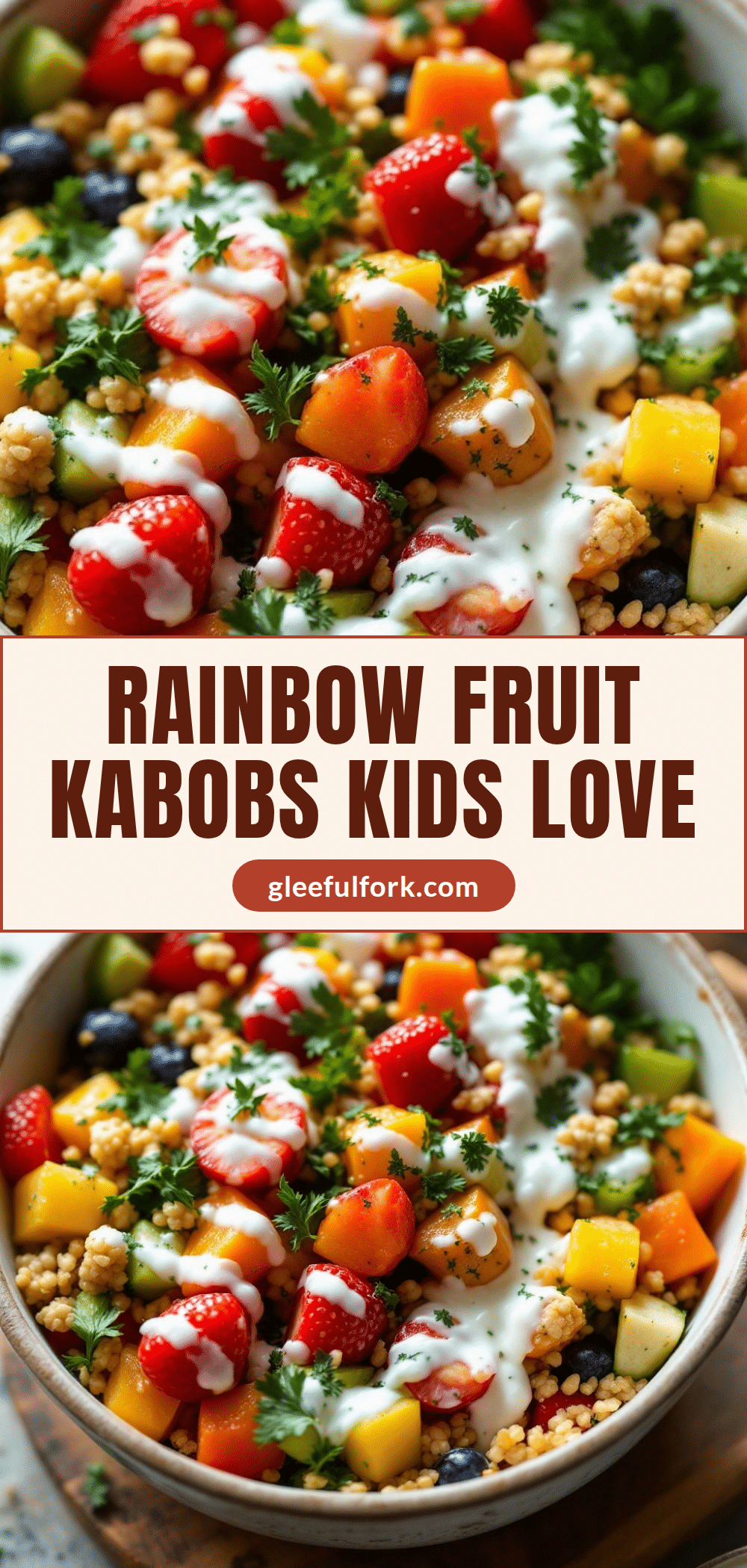
Easy Rainbow Fruit Kabobs: Best Healthy Snack for Kids
These colorful fruit kabobs are a fun, healthy snack that kids love to help make and eat. Packed with fresh fruit and no added sugar, they’re perfect for parties, playdates, or a simple afternoon treat.
- Prep Time: 15 minutes
- Cook Time: 0 minutes
- Total Time: 15 minutes
- Yield: 12 to 15 kabobs
- Category: Snack
- Cuisine: American
Ingredients
- Strawberries, hulled and halved
- Cantaloupe or honeydew melon, cut into 1-inch cubes
- Pineapple chunks, fresh or canned (drained)
- Green grapes, seedless
- Blueberries
- Red or purple grapes
- Wooden skewers, 8 to 10 inches long
- Marshmallows (optional)
- Mini cheese cubes (optional)
- Yogurt dip (optional)
- Coconut flakes (optional)
Instructions
- Wash and dry all fruit thoroughly.
- Prep each fruit type: hull strawberries and cut in half or quarters; cut cantaloupe into 1-inch cubes; leave grapes whole; blueberries as-is.
- Arrange the fruit in separate bowls in rainbow order: red (strawberries), orange (cantaloupe), yellow (pineapple), green (green grapes), blue (blueberries), purple (red grapes).
- Start threading the skewers: begin with a strawberry piece at the bottom, pushing it about halfway down the skewer.
- Follow the rainbow order: strawberry, cantaloupe, pineapple, green grape, blueberries, and finish with a red or purple grape. Leave about an inch of skewer at the top.
- Repeat with remaining skewers, using 6 to 8 pieces of fruit per skewer. Makes about 12 to 15 kabobs.
- Arrange on a platter in a single layer. Serve immediately or refrigerate.
Notes
Use firm, ripe fruit to prevent mushiness. Cut fruit into uniform 1-inch pieces for even threading. Leave about an inch at the bottom of the skewer as a handle. For toddlers, snap skewers in half. If using apples or bananas, toss with lemon juice to prevent browning. Best eaten within a few hours of assembly.
Nutrition
- Serving Size: 1 kabob
- Calories: 5570
- Sugar: 1014
- Carbohydrates: 1418
- Fiber: 23
Keywords: fruit kabobs, rainbow fruit skewers, healthy kids snack, easy fruit recipe, no-cook snack, party appetizer